🦎 The Incredible World of Chameleons
Chameleons are some of the most fascinating reptiles on Earth. They are famous for their color‑changing skin, turret‑shaped eyes, and lightning‑fast tongues. There is so much more to these amazing creatures than meets the eye. Let’s explore their colorful and surprising world.
🌈 Chameleons Don’t Change Color Just to Hide
Most people think chameleons change color only to blend in, but that is not their main reason. Chameleons shift their skin color to communicate their mood, attract mates, intimidate rivals, and control their body temperature. Dark colors help them warm up and lighter colors help them cool down.
They change color using tiny nanocrystals inside special skin cells called iridophores. By adjusting the spacing between these crystals, they reflect different wavelengths of light. This creates blues, greens, yellows, reds, and even purples.
👀 Eyes That Move Like No Other Animal
A chameleon’s eyes are truly extraordinary. Each eye sits inside a cone‑shaped turret of fused eyelids, leaving only a tiny opening for the pupil. Their eyes can rotate independently, giving them nearly full‑circle vision. One eye can look forward while the other looks backward.
Chameleons have excellent color vision and can even see ultraviolet light. Scientists discovered that their optic nerves are coiled, which gives their eyes the slack needed to swivel so dramatically.
👅 A Tongue Faster Than a Blink
Chameleons are insect‑catching champions. Their projectile tongues can shoot out in a fraction of a second, faster than the human eye can blink. Their tongues can be longer than their entire body. The sticky tip helps them snatch insects with incredible accuracy.
🌍 Where Chameleons Live
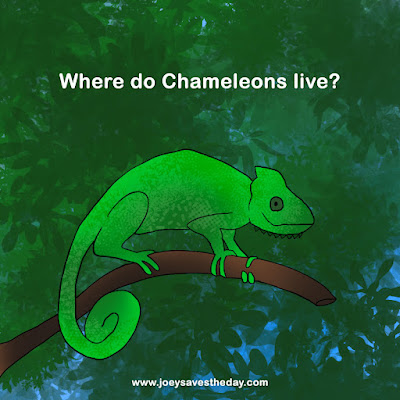
Chameleons are mostly found in Madagascar, mainland Africa, parts of Europe, the Middle East, India, and South Asia. They prefer forests, savannas, scrublands, and tree‑filled habitats. Their gripping feet and prehensile tails help them climb and balance in the branches.
🦎 Amazing Chameleon Body Features
Chameleons have some of the coolest physical adaptations in the reptile world. Their feet are shaped like pincers, which helps them grip branches. Their tails act like a fifth limb and help them stay balanced. Most species live in trees and prefer to be alone. Some female chameleons can lay fertilized eggs years after mating.
🐣 Baby Chameleons Are Called Hatchlings
Baby chameleons are known as hatchlings. They emerge fully independent and ready to hunt tiny insects.
🍽️ What Chameleons Eat
Most chameleons are insectivores. They eat crickets, grasshoppers, flies, and beetles. Larger species may also eat small vertebrates or nibble on plants.
📏 How Big Are Chameleons
Chameleons come in all sizes. Chameleons come in all sizes. The tiniest species is less than one inch long. The largest species can grow to about two feet in length. Most chameleons live three to ten years depending on their size and habitat.
⚠️ Are Chameleons in Danger
Many chameleon species are threatened due to habitat loss, deforestation, and illegal pet trade. Madagascar’s unique species are especially vulnerable. Conservation efforts help protect these incredible reptiles.
🦎 Extra Fun Chameleon Facts
- Chameleons can see more colors than humans, including ultraviolet light.
- They are almost blind at night because their eyes are built for daytime color vision.
- Some chameleon species can vibrate to communicate through the branches they sit on.
- Their color change is often social and used to communicate.
- There are around two hundred species of chameleons worldwide.
🦎 Chameleon Color‑Change Activity
Let’s learn how chameleons use color to communicate.
Kids will explore emotions, colors, and creativity while pretending to be chameleons.
What You Need
Paper
Crayons or markers
Pencil
Optional: scissors and glue
Activity Steps
1. Draw a Chameleon
Have your child draw a chameleon or print a simple outline.
Encourage them to add big eyes and a curly tail.
2. Learn the Color Meanings
Explain that chameleons change color to show how they feel.
Use these simple kid‑friendly meanings:
Green means calm
Yellow means excited
Red means angry
Blue means relaxed
Purple means playful
3. Color the Chameleon for Each Mood
Ask your child to color the chameleon five different ways.
One chameleon for each mood listed above.
They can draw five small chameleons or color the same one five times.
4. Write a Sentence for Each Mood
Under each chameleon, have your child write a sentence.
For example:
The chameleon is yellow because it is excited.
The chameleon is blue because it feels relaxed.
5. Create a Chameleon Mood Chart
Have your child glue each colored chameleon onto a sheet of paper.
Label it Chameleon Mood Chart.
This becomes a fun visual showing how chameleons communicate.
Click on picture above to download worksheet
Extension Ideas
- Let your child invent a new color and mood for a chameleon.
- Have them write a short story about a chameleon changing colors throughout the day.
- Turn the mood chart into a classroom or home feelings chart.
Get your free printable Chameleon coloring sheet here:
Click on the link or picture below to print out your free worksheet.
CLICK HERE
Books about Chameleons:
1. Chameleons Are Cool by Martin Jenkins
2. Born To Stand Out by Nikki Rogers
3. National Geographic Readers Animals That Change Color by
Libby Romero
4. A Color of His Own by Leo Lionni
Parents/caretakers, be sure books are child-friendly before
reading them to your child/children.
Short Story Alert:
Frankie and Fancy: The No‑Mirror Mystery
by Mimi Jones
Once upon a time, in a warm and wiggly forest in Madagascar, there lived a teeny tiny Brookesia nana chameleon named Frankie. Frankie was so small that if he sneezed, the breeze could accidentally relocate him. His best friend was Fancy, a big and beautiful Parson’s chameleon who was basically the size of a small tree branch with legs.
Frankie always believed he must be just as big and colorful as Fancy. Why wouldn’t he be? He felt big on the inside. Meanwhile, Fancy was convinced she must be as small and delicate as Frankie. She moved gently and carefully, trying not to step on imaginary tiny things she thought she matched in size.
There were no mirrors in the forest, so neither of them had any idea what they actually looked like. They just assumed.
Frankie tried to do everything Fancy did. If Fancy climbed a tall branch, Frankie climbed it too. It took him three hours, two snack breaks, and one motivational pep talk from a passing gecko, but he always made it. Fancy tried to do everything Frankie did. If Frankie squeezed into a tiny crevice, Fancy tried to follow. She usually got stuck halfway and had to wiggle backward like a confused bulldozer.
Even though they were completely different sizes, they never noticed. They grew together, played together, and loved one another exactly as they were. When Frankie looked at Fancy, he didn’t see “big.” When Fancy looked at Frankie, she didn’t see “small.” They only saw their friend.
Imagine a world with no mirrors. Maybe we would all see each other the way Frankie and Fancy did... with kindness, curiosity, and no worries about size, shape, or color.
THE END.
Chameleons are truly amazing creatures with unique abilities and colorful personalities. From their fast tongues to their incredible eyesight, they remind us how wonderfully diverse nature can be. I hope you enjoyed learning all about these fascinating reptiles.
Return back to the Creature Hub.


.jpg)


